
Making Music with Your Ears
An interview with Levi Clay

In a music industry obsessed with performance and celebrity, one musician has built an extraordinary career doing something most people don’t even know is a job. While most assume a life in music means making money with your voice or your instrument, Levi Clay makes his living with his ears. As one of the world’s most recognized transcribers - with over 38 million YouTube views and more than 20 published books - he has spent years proving that listening is a skill worth mastering.
In an online guitar scene that often prioritizes entertainment over education, Levi stands apart. Through his Guided Practice Routines, he’s building a community focused not just on technical improvement, but on developing true musicianship - with ear training at its center. When discussing his work, Levi has no interest in putting on a show. What follows is an honest conversation about transcription, listening, and what it really takes to grow as a musician.
Most of us picked up the guitar because of a feeling - a song that moved us, a part of ourselves we wanted to explore. Many of us have also quietly wondered whether we started too late or whether the gap between where we are and where we want to be is simply too wide. Levi’s answer is clear: the tools you need are more accessible than you think, and the most important one isn’t your fingers. It’s your ears.
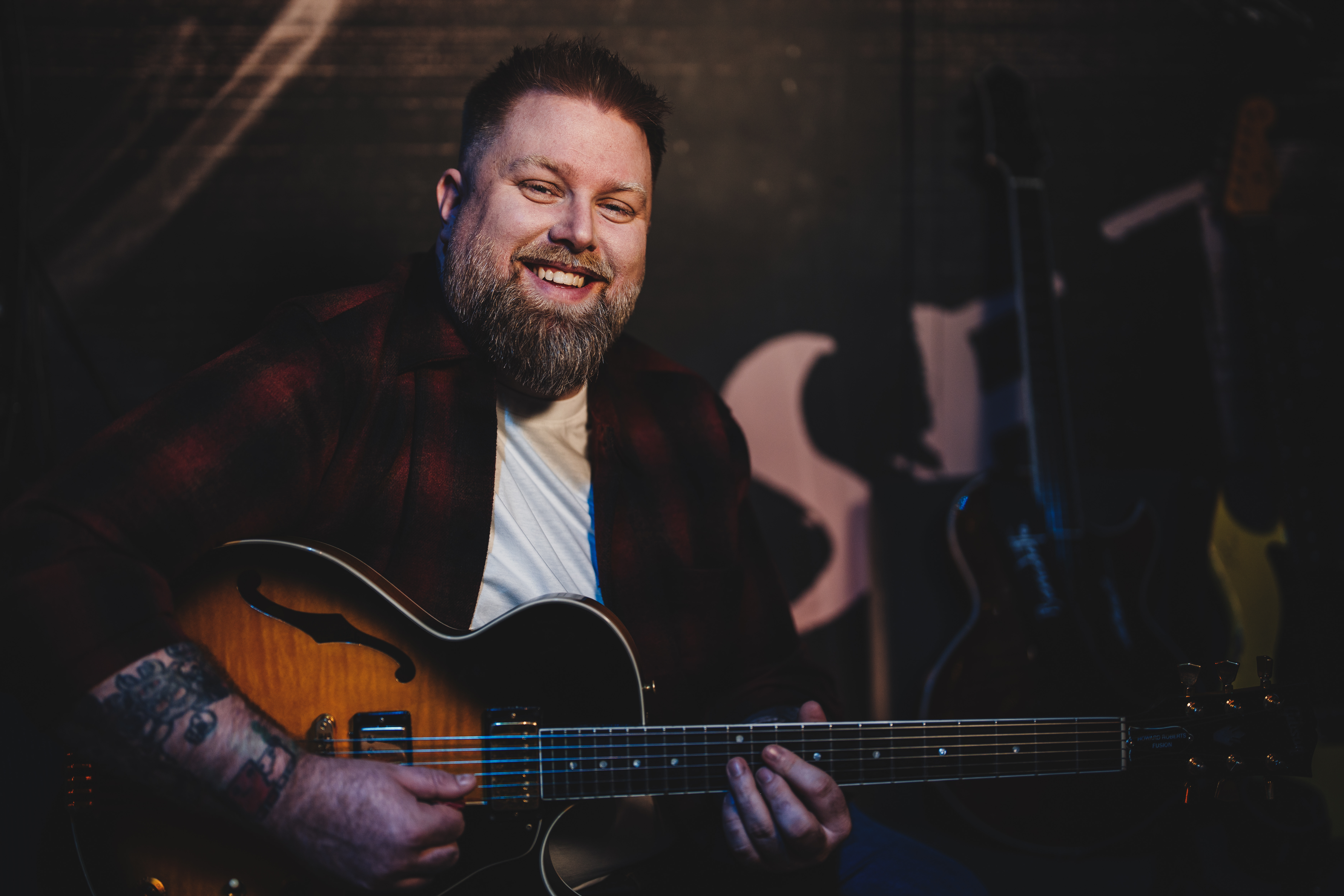
The Man Who Listens for a Living
When did you first realize that your ears, rather than your instrument or voice, were your most valuable professional asset?
While I was at music school I really got heavy into transcribing, it wasn't really related to school, but I just found myself doing it for a few hours every night. Some of my work got around and people started emailing me wanting to pay me to do jobs. Music school is cool, because you're in an area surrounded by musicians, but that means for gigs the economy is ruined. Supply far outstrips demand so gigs were few and far between, and barely paid. But transcribing was paying my rent, so it felt like a no brainer to steer into it.
How do you describe what you do to people outside the music world, and does their reaction ever surprise you?
It's such a weird one because non musicians just assume someone like Eric Clapton can read. Why wouldn't he be able to? They remember having music classes as a kid and the first thing they had to do was learn to read, that's why they stopped. I think of myself as a conduit for amazing players who can do all this cool stuff but don't find the academic stuff like writing it out or explaining the why very easy. And when that fails you just tell them you're a music teacher and writer with 20 books out. I wouldn't say it surprises me, but it's a shame that "musician" is often met with groans and "oh, my mate Dave plays the guitar too", it's like it can't be a real job to them, so you have to steer into the side of your work that they accept. Like my car insurance has me listed as an author.
Was there a single transcription that made you think, “This is what I’m meant to do”?
Probably not a single one (though there are plenty that have left me thinking "why am I doing this?"), but many of them give me that feeling. I think of transcription like puzzle solving. You start with a blank page and decipher everything until you have this beautiful piece of art at the end. I've always been into more analytical hobbies, so it really speaks to my nature. The "meant to do" bit is the bit that you're really asking, and that's easy. Youtube. I've racked up 38 million views at this point, and although I was transcribing LONG before posting on Youtube, back then this was what I had to do. But when you put your work out there and millions of people all over the world use and enjoy it? That's when you cross into that feeling of finding meaning.
How has your approach to ear training changed over the years? Are there things you used to do that you’ve completely abandoned?
Oh 100%! I mentioned music school, and I have a lot to say about the state of modern music education. Schools pumping out 100s of students with the same degree, the degree ends up not meaning much. After all, we all have to do the same classes and so the class isn't written for the guy who's played keys in church all his life, it's written to make sure the singer who doesn't play an instrument can also pass. I describe it as parlour trick learning. I transcribe for a living, and never have I listened to two notes and said "oh, that's a 6th". It's just not something you use outside of tests, but the stuff you do use is hard to test, so it's ignored.
Audiating is the big one. Hearing sounds before they happen. Can you sing a dominant 7 arpeggio without playing it etc. Sing everything you play, and try and sing it BEFORE you play it, you're trying to connect your ears and fingers so when you hear a sound, you just know where it is. The other one is bass notes. If you can't put a song on and just sing the lowest notes of the chords, go there. We hear sounds in relation to the chord, if you can't hear the lowest note, you're in trouble!
There’s no conservatory degree called “Professional Transcriber.” How did you build credibility in a field without a formal gatekeeping structure?
It's always been word of mouth. Prior to Youtube blowing up I'd never really put myself out there and offered the service, I just worked with famous players their friends would see them releasing products and ask how, and they'd put me in touch. To me, credibility comes from the calibre of people you work with, not just who consumes the work.
Your reputation is entirely built on your output. Does that feel freeing, or is there a kind of pressure that comes along with it?
It is amazing to feel like I can do whatever I want and what interests me. I don't chase numbers, I genuinely make things that interest me. I know when I post a Jerry Reed video, it will only get 10% of the views that say, a Paul Gilbert video would, but I really do think of myself as an archiver, trying to preserve history and teach up and coming players about some of these great players from the past you might not be hip to. Plus, I think a lot of content creators suffer from burnout, and that comes from being stuck making things you don't love but have to. Everything I make I would be doing for myself if I didn't have an audience.
You’ve become a go-to resource for ear training. How has teaching others improved your own skills?
Teaching is great for keeping you grounded. As a teen all I wanted to be able to decipher was Tunnel Vision by Tribal Tech, but that's SO niche that when I sat and did it a couple of years ago all I got was that buzz of solving a puzzle. Learning piano in the last 6 years has improved my ear so much and so now there's rarely a moment where a student brings up a song or plays me something where I ever have the panic of "oh, what was that?". I live in that space that working musicians need to be in. Got a call for a gig next week and need to learn 20 songs? Cool. No sweat.
What is the most common misconception guitarists have about developing their ear?
They think it's boring, and that they need to know theory. When I started putting my ear training course together, I started from a completely pragmatic, non theory approach, because you don't need to know theory to have a great ear. You don't need to be able to read/sight sing to have have a great ear. There are too many examples of great jazz musicians who know little to no theory or are blind who play like monsters! And it's because they can play anything they hear.
How have digital technology and platforms like YouTube changed the demand for, and the perception of, transcription work?
Oh man... AI. Let me be clear, AI is currently useless for transcribing, and I'm pretty confident it will always be useless. I've explained why in videos online years ago and been told how wrong I'll be this time next year etc, but here I am. When people want a transcription, they want expertise. Experience. Have you sat down and asked an AI like ChatGPT questions about music? It's wrong. All. The. Time. And people think you're going to trust something like that to reliably put out products? It's sad, in the last year or so I'm seeing a rise in comments on Youtube that accuse my videos of being AI. We're in a dark place where people have this ungodly faith in AI where you assume it can just do anything and that if someone has a skill you don't have... it must have been AI. It's dangerous because it results in people dismissing their own potential. No, AI doesn't do my work for me, this is a skill that I developed, and you can too! Sure, requires a lot of work, but just assuming you can take that shortcut is a big mistake. You can't just rely on computers (or anyone) to just do everything for you.
Do you think transcription as a profession will look different in ten years, especially with emerging AI audio tools?
I think it's going to make entry easier. And I should be clear, that's a good thing. I'm all about accessibility in music. Nothing worse that a Bach guy telling you you're disrespecting the music by using tab. No man, you're just upset at the idea that some guy who just enjoys music but has kids and a job can now give the music he loves a try and he doesn't have to go to school for 10 years. There's going to be a split like we have now, but greater. As it stands there are two types of transcriptions you see. Ones done by people who understand and appreciate the conventions of music, and ones done by people who just trial an error it until the MIDI sounds right. AI tools already make it easy to isolate the guitar on a track, and that feels like a nice thing to do, but I caution you against it. All you're doing by doing there is creating a reliance on tech that isn't there in the real world. I can already isolate the guitar on a track without AI... in my head. That's the skill you need to develop sooner or later. Listening to an ensemble and just focusing on the part you want to hear. It will all come down to how people want to use AI. As a tool to help them learn, or as a substitute so they don't have to.
What does it mean to you to be recognized as a leader in this field without a formal title or institution behind you?
Well it highlights how little titles mean, because I've got letters after my name and they don't mean anything! It's honestly amazing to have so many people think of me as a leader in the field and that's an honour I don't take lightly. Having said that, I'm always looking to change that. I'm so lucky that my work allows me the freedom to be flexible with my time now and so this year is the year I want to aggressively give back. So music schools, colleges, bloggers, guys with podcasts, if you want me to come and talk to you or your students, I'd love to! Let's start making a future where the community develops their ears and maybe start the next generation of transcribers!
Next time you sit down with your guitar and struggle to pick out a melody by ear, or feel like true musicianship is only for those who started young or went to school for it, remember this conversation. Here is someone who built an entire life around listening — and his clearest message to you is that the ear is trainable, theory is optional, and the music you love is well within your reach. You don’t need a stage. You just need to keep showing up.