


I have a funny story about the CAGED system.
Back in the early days of Guitar Noise, we managed to talk a few actual guitar heroes into answering a batch of emailed questions, mostly because nobody had told them yet that they didn’t have to say yes to a guy with a website and a list of questions.
I could have gone after Malmsteen, or Kip Winger. But who I really wanted to talk to was Bill Edwards. His Fretboard Logic series was my real introduction to CAGED, and in my excitement about landing the interview, I did something a little embarrassing: I let it slip that I thought Bill had invented the whole system.
Bill’s reply came back with a laugh built right into it. He hadn’t invented it, and patiently explained what his actual contribution was, while I nodded along at my screen like I’d known that all along. You can read the whole interview here if you want the unedited version of me getting corrected.
I never really stopped digging into CAGED after that conversation, and somewhere along the way I think I turned into a CAGED historian, which is a title nobody asked me to have. Who invented it? Where did it come from? Back then the answer meant tracking down a guy through a magazine and hoping he’d call you back. These days you can get most of it from a laptop and a couple of very good YouTube teachers, which we’ll get to. But the real answer is a lot messier than “some guy came up with five chord shapes,” and it starts about 500 years before that guy was even born.
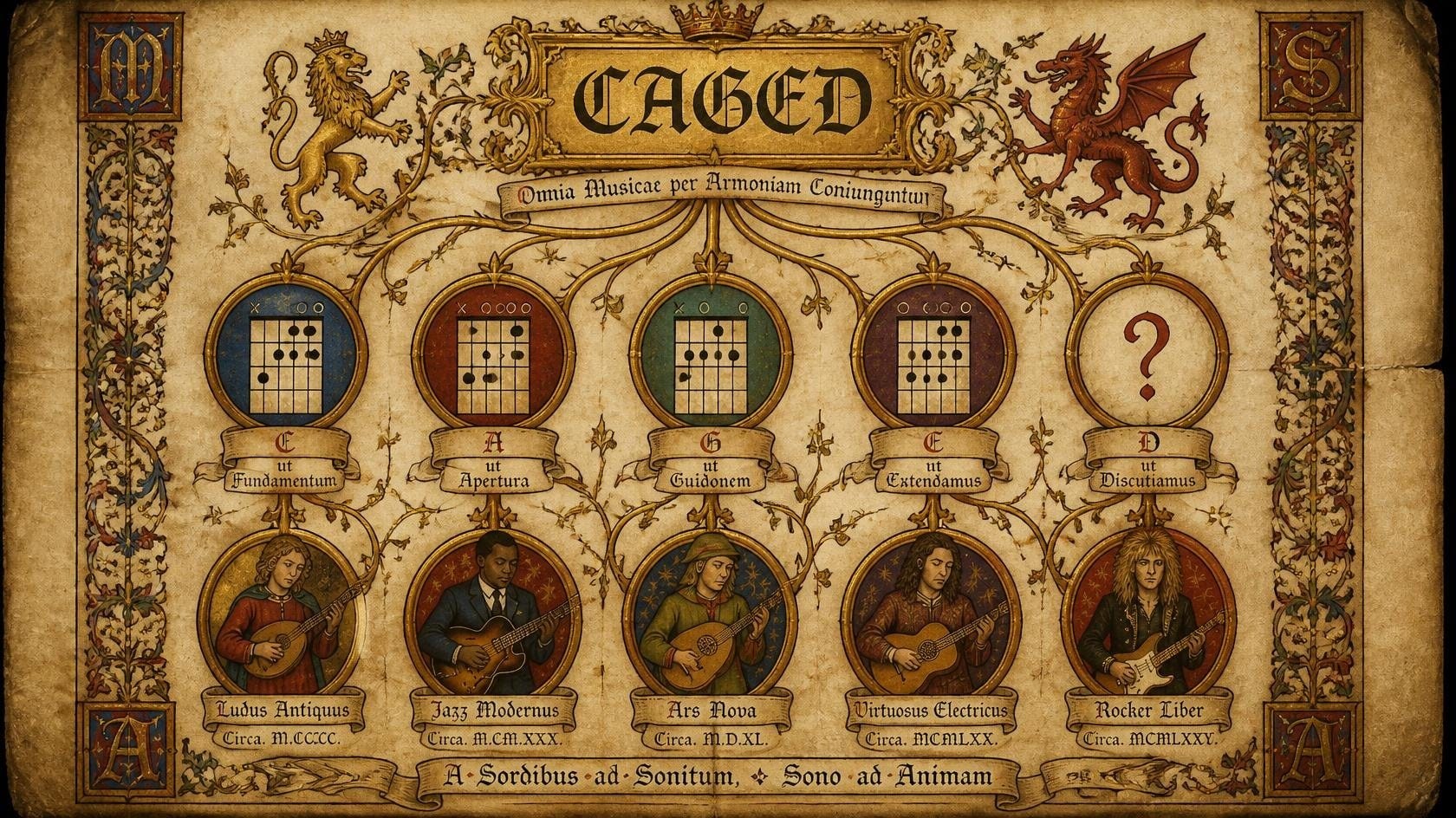
I. The Prime Mover
To understand CAGED you have to go back further than any guitarist, back to 16th-century Italy and a tuning decision nobody remembers making.
Renaissance lutes were tuned E-A-D-F#-B-E, with a major third between the D and F# strings. In the mid-1500s, Italian musicians adapted that tuning for a Baroque relative of the guitar called the chitarra battente. They nudged the F# down to G, shifting that major third one string over, from D/F# to G/B. Sounds like a small tweak. It was mostly about getting chord shapes to actually fit under a human hand rather than one built like a spider.
That relocated third is the whole reason the guitar behaves differently from a piano or a violin. Every other interval between the strings is a perfect fourth, five semitones. Except that one G-to-B gap, which is only four. That asymmetry is what makes chord shapes movable and interlocking in the first place. A perfectly symmetrical tuning would actually make CAGED impossible.
Two centuries later, in the late 1700s, instrument makers started adding a sixth string below the existing five. To keep the established fourths intact, a low E was the obvious choice, mirroring the high E on the other end. That symmetry is why barre chords work the way they do. Slide the same shape up or down and you get the same chord anywhere on the neck, because the relationship between the strings never changes.
Bill Edwards himself points to this. He’s on record saying the real inventor of CAGED is whoever devised standard tuning in the first place, some unsung genius nobody can even name. Every guitarist who’s ever noticed the five shapes was really just rediscovering the fingerprints of that one 16th-century decision.
II. An Age Without a Name
Once that tuning existed, the five-shape pattern was baked in, waiting for anyone curious enough to notice it. And guitarists did, long before “CAGED” was a word anyone used.
The Eddie Lang Guitar Method from 1935 and the George Barnes Guitar Method from 1943 both build solos out of the same five shapes. Around that same era, Django Reinhardt, playing with only two fully functional fretting fingers after a caravan fire, built his own private map of the neck out of sheer necessity, moving a handful of shapes around to keep playing at a virtuoso level. Decades later, Jimi Hendrix did something similar. He never learned “the CAGED system” since it hadn’t really been defined yet in his lifetime, but the triadic, shape-shifting logic running through his rhythm playing is the same pattern. Guitar teachers still point to his habit of grabbing the middle four strings of a G-shape chord as a textbook example of CAGED thinking, decades before there was a textbook.

III. The Naming
The earliest documented print reference shows up in a May 1975 issue of Guitar Player Magazine, in a piece on San Francisco’s Blue Bear School of Music. It profiles the school’s 20-year-old guitar instructor, Keith Allen, and buried in there is the logic of five interlocking scales, E-D-C-A-G. First time the idea got written down and given a name.
Allen wasn’t some obscure hobbyist, either. He was the Bay Area’s go-to studio guitarist, gigging with everyone from the San Francisco Symphony to Bonnie Raitt and the Steve Miller Band, which probably explains how a twenty-year-old ended up with enough credibility to land a feature in a national magazine. You can still find the original 1975 article and the backstory behind it, scanned from an old Xerox copy, on the website of the company that later published his poster.
IV. The Poster That Carried It Across the Land
In 1980, a company inspired by the old Woodstock poster released The Guitar Poster, a wall chart packing the whole CAGED sequence onto one laminated sheet. More than any magazine article, this is probably what actually spread CAGED into bedrooms across the country. It’s still sold today. I remember seeing it on college dorm walls and wondering what all the strange hieroglyphics meant. It was a secret world, like messages from inside an Egyptian pyramid. My guess was only off by a few centuries.
Allen didn’t just license his name to the project, either. According to the poster’s own thirty-year retrospective, he sat down with the prototype and personally roughed out the chord and scale reference table by hand, then stayed on as music editor. He went on to write and edit companion posters for keyboard, bass, and rock guitar before he passed away, still teaching private students right up until the end.
V. The Disputed Champion
Joe Pass made CAGED famous in jazz circles, though some guitarists who’ve studied his books closely argue he was mostly using the idea to visualize chords rather than the full five-position scale system that gets taught today. His instructional material also leaned heavily on a collaborator, Bill Thrasher, who reportedly wrote something like 200 pages of it and, by one account, wasn’t exactly thrilled about how the credit shook out.
That collaboration produced Joe Pass Guitar Style, a slim 60-page book that’s quietly become one of the most recommended jazz guitar texts around, with bassist Carol Kaye herself said to still point students toward it decades later. A long-running jazz guitar forum thread breaks down just how much of Pass’s recorded legacy runs through material Thrasher actually put on the page, which makes the credit question feel less like trivia and more like an actual injustice.
VI. The Systematizer
Bill Edwards didn’t invent CAGED. He’s said so himself, noting the chordal side of it already had a name before he was born. What he did was systematize the whole pattern, chords, scales, and lead shapes, into Fretboard Logic, a self-published series that ended up outselling Mel Bay and Hal Leonard titles with zero corporate backing behind it. The book was reportedly first titled simply “The CAGED System,” which tells you Edwards saw himself as extending a tradition rather than founding one.
Edwards came at the guitar sideways, too, which might explain why his explanation clicked with so many self-taught players. He started on piano as a kid, only picking up guitar later, and the whole project reportedly grew out of a single guitar student asking him how he was able to figure songs out just by ear. Trying to actually answer that question is what eventually became three volumes and a small library of instructional video.
VII. A Disputed Genealogy
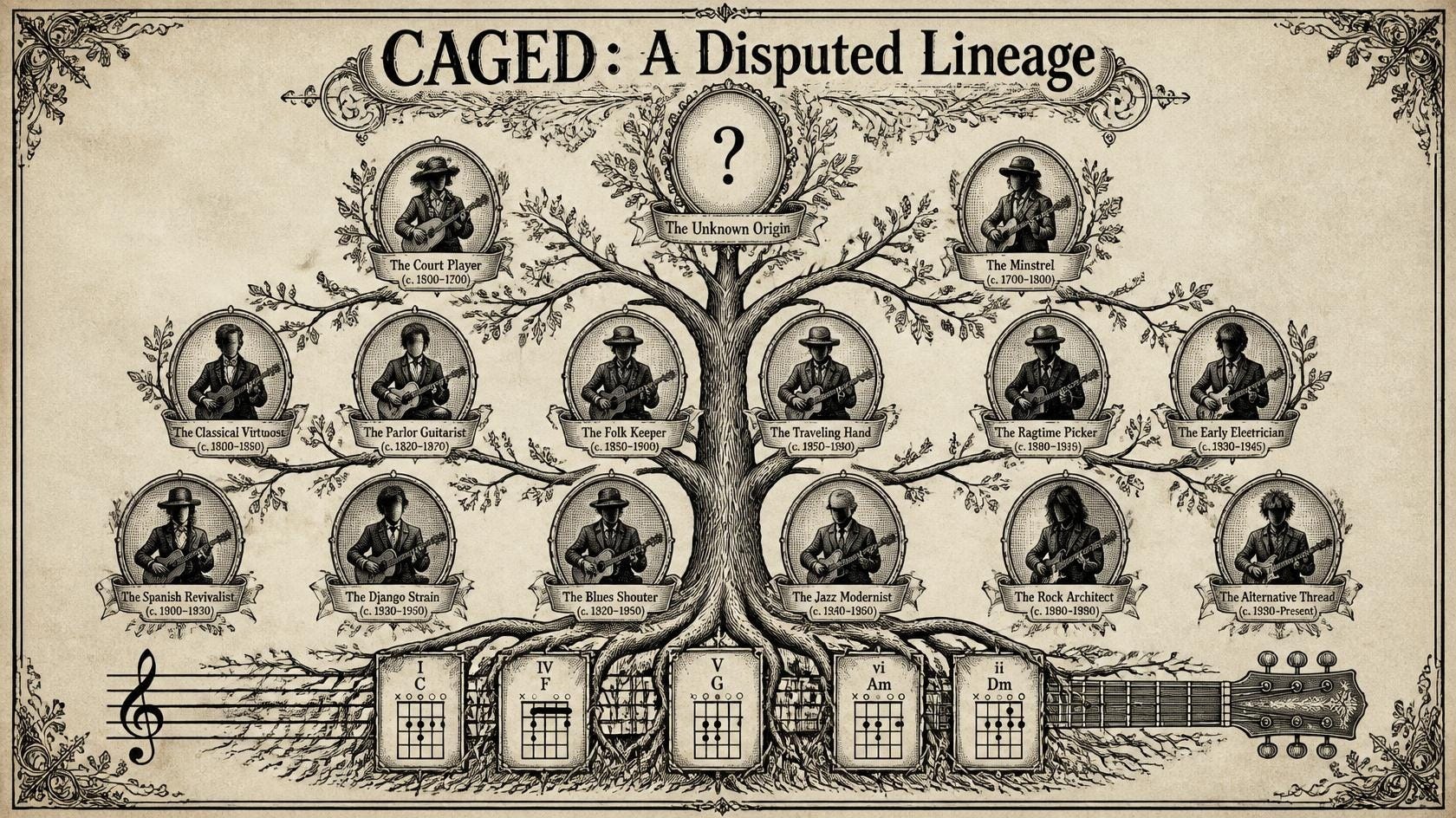
The publisher behind The Guitar Poster has actually published a formal defense of Keith Allen’s claim to the name, receipts and all. Ask around elsewhere and you’ll hear different names entirely. Nobody really agrees, because nobody invented this in one stroke. It got rediscovered independently, over and over, by guitarists solving the same problem a 16th-century tuning decision created for them.
Gypsy jazz players offer a good example of that independent rediscovery still happening today. Some teachers in that world, including Stephane Wrembel, reportedly work with beginners using a reduced three-shape variant sometimes called ACE, a name few players outside the gypsy jazz world have ever heard. It’s discussed in some detail on a Django Reinhardt forum, where several posters realize mid-thread that they’ve been using some version of it for years without ever having a name for it, which is basically the entire history of CAGED in miniature.
VIII. The Heretics
CAGED has spent the last decade or so absorbing some real pedagogical pushback, mostly around awkward fingerings when patterns shift from three notes per string to two, and around how the “everything’s a major scale variant” framing falls apart once you hit melodic minor and beyond. Some jazz players go further and argue it fractures the fretboard into five disconnected boxes instead of one continuous space.
The bigger shift, though, isn’t the criticism, it’s how people actually encounter CAGED now. For decades that meant a book, a poster, or a teacher passing it down in person, the way Edwards did. Today it’s far more likely to be a YouTube video from Justin Sandercoe, whose free site JustinGuitar has become one of the most-watched guitar education platforms in the world. His own CAGED lesson makes almost the same point this piece opened with, that nobody invented it, it’s just the logic the guitar’s tuning produces. For a huge chunk of guitarists learning today, Sandercoe, not Edwards or a poster on a dorm wall, is CAGED’s actual point of entry.
One of the more convincing modern reworkings comes from Levi Clay, a contemporary teacher I’ve interviewed myself, whose site Guided Practice Routines covers a huge amount of fretboard ground while only really teaching three positions instead of five. His argument is that the C and D shapes largely duplicate territory you’ve already covered with the other three, so dropping them doesn’t cost you coverage of the neck, it just cuts the redundant memorization. It’s a small, practical edit to a fifty-year-old idea, and a good reminder that CAGED is still very much a living, contested system rather than a museum piece.

Coda
CAGED wasn’t invented on some Tuesday afternoon by a guy with a notebook. It’s the 500-year-old fingerprint of an Italian tuning shortcut, rediscovered independently by Django, by Hendrix, by a string of swing-era method writers, before finally getting named by a 20-year-old teacher in 1975, mass-marketed by a poster in 1980, adopted loosely by Joe Pass, and systematized decades later by a self-published piano player who never once claimed credit for any of it. The most “obvious” idea in guitar pedagogy has never had a peaceful, uncontested history.
Feels about right for an instrument where five different people can stare at the same fretboard and see five completely different maps. Including, apparently, a wide-eyed interviewer who once fired off an email assuming the guy on the other end had invented the whole thing himself.
Based on the interview that you linked in the article, I bought Fretboard Logic Box Set Deluxe 3+3 directly from his website, not from Amazon. Looking forward to working with it. - Great interview! Thanks.
I initially wrote off the CAGED system as a newfangled, fashionable method. I was very wrong. Even for just understanding or visualising chords and scale positions across the neck, CAGED is wonderful. It takes time to memorise and become automatic, but the long-term benefits are worth it.